Loading...
Feature
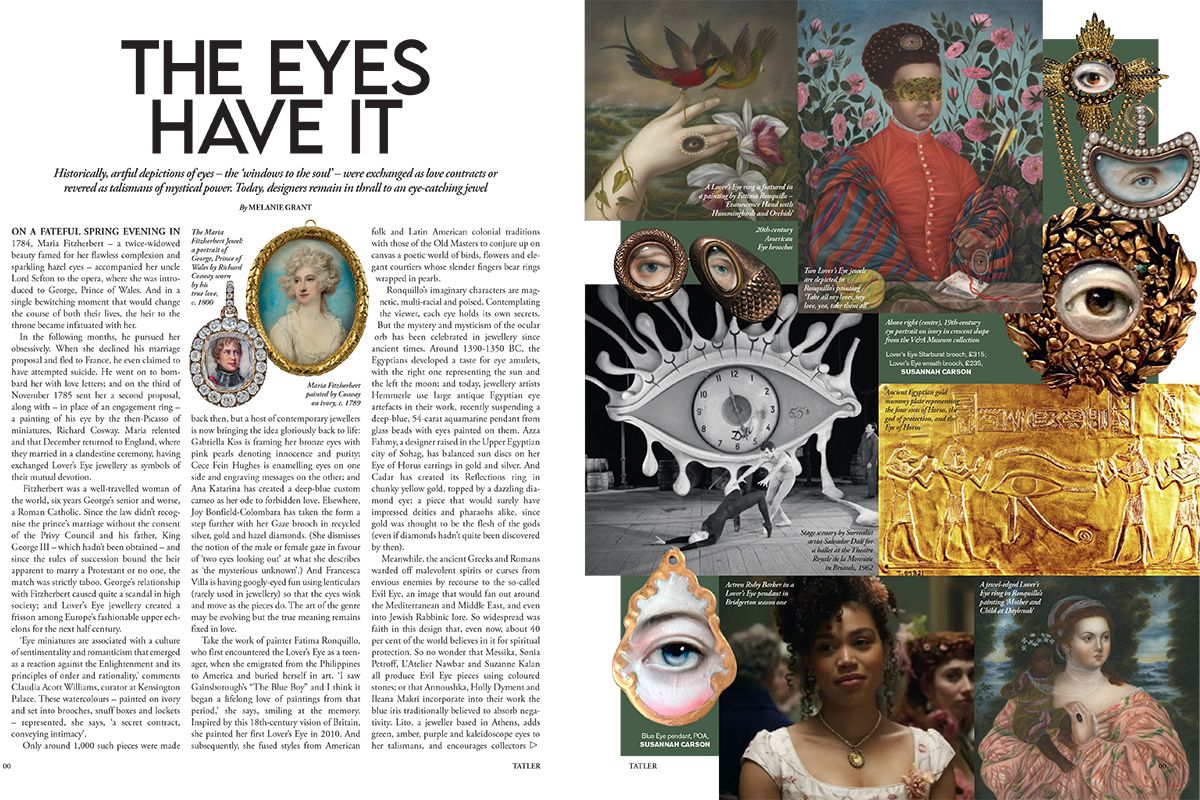
1784, Maria Fitzherbert – a twice-widowed beauty famed for her flawless complexion and sparkling hazel eyes – accompanied her uncle Lord Sefton to the opera, where she was introduced to George, Prince of Wales. And in a single bewitching moment that would change the course of both their lives, the heir to the throne became infatuated with her.
In the following months, he pursued her obsessively. When she declined his marriage proposal and fled to France, he even claimed to have attempted suicide. He went on to bombard her with love letters; and on the third of November 1785 sent her a second proposal, along with – in place of an engagement ring – a painting of his eye by the then-Picasso of miniatures, Richard Cosway. Maria relented and that December returned to England, where they married in a clandestine ceremony, having exchanged Lover’s Eye jewellery as symbols of their mutual devotion.
Fitzherbert was a well-travelled woman of the world, six years George’s senior and worse, a Roman Catholic. Since the law didn’t recognise the prince’s marriage without the consent of the Privy Council and his father, King George III – which hadn’t been obtained – and since the rules of succession bound the heir apparent to marry a Protestant or no one, the match was strictly taboo. George’s relationship with Fitzherbert caused quite a scandal in high society; and Lover’s Eye jewellery created a frisson among Europe’s fashionable upper ech-elons for the next half century.
‘Eye miniatures are associated with a culture of sentimentality and romanticism that emerged as a reaction against the Enlightenment and its principles of order and rationality,’ comments Claudia Acott Williams, curator at Kensington Palace. These watercolours – painted on ivory and set into brooches, snuff boxes and lockets – represented, she says, ‘a secret contract, conveying intimacy’.
Only around 1,000 such pieces were made back then, but a host of contemporary jewellers is now bringing the idea gloriously back to life: Gabriella Kiss is framing her bronze eyes with pink pearls denoting innocence and purity; Cece Fein Hughes is enamelling eyes on one side and engraving messages on the other; and Ana Katarina has created a deep-blue custom cameo as her ode to forbidden love.
Elsewhere, Joy Bonfield-Colombara has taken the form a step further with her Gaze brooch in recycled silver, gold and hazel diamonds. (She dismisses the notion of the male or female gaze in favour of ‘two eyes looking out’ at what she describes as ‘the mysterious unknown’.) And Francesca Villa is having googly-eyed fun using lenticulars (rarely used in jewellery) so that the eyes wink and move as the pieces do. The art of the genre may be evolving but the true meaning remains fixed in love.
Take the work of painter Fatima Ronquillo, who first encountered the Lover’s Eye as a teenager, when she emigrated from the Philippines to America and buried herself in art. ‘I saw Gainsborough’s “The Blue Boy” and I think it began a lifelong love of paintings from that period,’ she says, smiling at the memory. Inspired by this 18th-century vision of Britain, she painted her first Lover’s Eye in 2010. And subsequently, she fused styles from American
folk and Latin American colonial traditions with those of the Old Masters to conjure up on canvas a poetic world of birds, flowers and elegant courtiers whose slender fingers bear rings wrapped in pearls. Ronquillo’s imaginary characters are magnetic, multi-racial and poised. Contemplating the viewer, each eye holds its own secrets. But the mystery and mysticism of the ocular orb has been celebrated in jewellery since ancient times.
Around 1390-1350 BC, the Egyptians developed a taste for eye amulets, with the right one representing the sun and the left the moon; and today, jewellery artists Hemmerle use large antique Egyptian eye artefacts in their work, recently suspending a deep-blue, 54-carat aquamarine pendant from glass beads with eyes painted on them. Azza Fahmy, a designer raised in the Upper Egyptian city of Sohag, has balanced sun discs on her Eye of Horus earrings in gold and silver. And Cadar has created its Reflections ring in chunky yellow gold, topped by a dazzling diamond eye; a piece that would surely have impressed deities and pharaohs alike, since gold was thought to be the flesh of the gods (even if diamonds hadn’t quite been discovered by then).
Meanwhile, the ancient Greeks and Romans warded off malevolent spirits or curses from envious enemies by recourse to the so-called Evil Eye, an image that would fan out around the Mediterranean and Middle East, and even into Jewish Rabbinic lore. So widespread was faith in this design that, even now, about 40 per cent of the world believes in it for spiritual protection. So no wonder that Messika, Sonia Petroff, L’Atelier Nawbar and Suzanne Kalan all produce Evil Eye pieces using coloured stones; or that Annoushka, Holly Dyment and Ileana Makri incorporate into their work the blue iris traditionally believed to absorb negativity.
Lito, a jeweller based in Athens, adds green, amber, purple and kaleidoscope eyes to her talismans, and encourages collectorS to travel with them to guard against mishaps. Should the wearer require 360-degree protection, Lauren Rubinski will enamel an entire necklace with eyes. And Pippa Small has created an eye collection in collaboration with Jordanian artisans which brings old skills to new jewels.
Despite the proliferation of such other eyes – and not forgetting Surrealist examples by Dalí and Man Ray, which more recently inspired Schiaparelli and Venyx – the Lover’s Eye endures. Susannah Carson, an academic-turned-artist who has painted nearly 2,000 such pieces – some of which have found their way into the
hands of Dita von Teese and Florence Welch – knows why. ‘In a world of abstraction and alienation in art and in life generally,’ she says, ‘we are all yearning for the most fundamental of human experiences: connection. We search for it in life, and we are drawn to it in art. The Lover’s Eye is, and always has been, a condensing and intensification of this connection.’
Back in Georgian England, and a few years after marrying George, Maria Fitzherbert found herself in a challenging situation. Parliament was demanding clarification of her status. Her prince – who was having affairs – had no intention of giving up his right to succeed to the throne. And what’s more, due to his extravagant lifestyle, he was in debt to the tune of £87 million in today’s money. The king came up with a solution: if George (officially) married his cousin Caroline, the Duchess of Brunswick, her father would pay off his creditors.
The prince acquiesced, informing Maria by letter a decade after he had gifted her that first Lover’s Eye. But as he lay dying some years later, he asked for a miniature of her eye to be tied around his neck, and he took it to the grave. In his will, he called her ‘the wife of my heart and soul’ and declared that, in the eyes of heaven, if not the law, Maria would forever be his.
Written by Melanie Grant for Tatler in October 2024.