Loading...
Feature
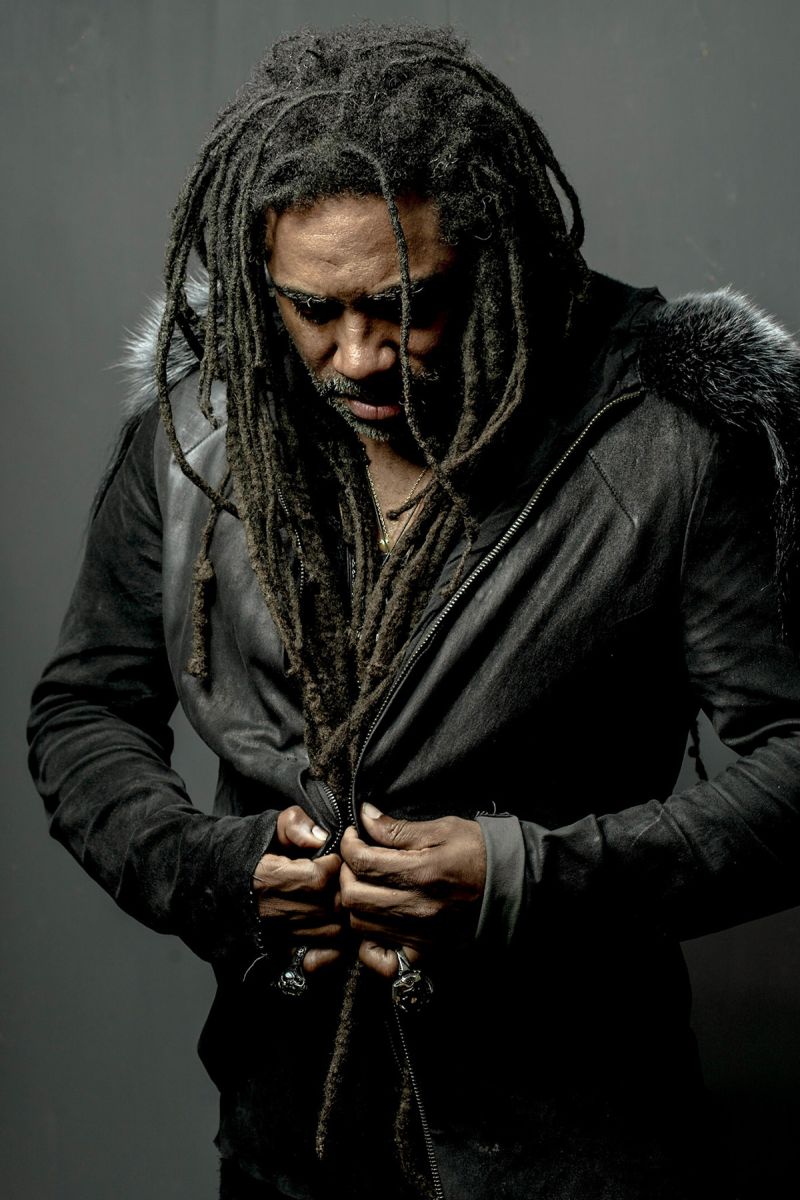
Toledo, Ohio is not known for its jewellery artists. An industrial town in America’s Rust Belt, it weathered enormous periods of boom and bust during the last century and was a beacon for the Great Migration, the period in the 1940s, ’50s and ’60s during which some five million African Americans surged north in the hope of finding jobs previously denied them. By the 1980s however, against a backdrop of crumbling factories, abandoned offices and a looming crack epidemic, the economy faltered, and a teenage Terry Castro took his first tentative step towards jewellery.
He collected discarded components which he made into his first jewels, and using his mother’s household tools, he created masks, strange animals and otherworldly objects infused with a darkness and decaying beauty that would come to permeate his work throughout his career. He was a dreamer with a penchant for the avant-garde, creating his own type of surrealism and lusting after the experimental styles of Comme des Garçons, Junya Watanabe and If Six Was Nine.
Castro sadly passed away quite suddenly, in 2022, at the age of 50. Today his son, Sir King Castro, is carrying on their father’s legacy with a new retrospective at Carpenters Workshop Gallery that provides an intimate look at the jeweller’s artistic process (“I would describe it as mythical, mystical and talismanic,” says Sir King), as well as more recently designed pieces that speak to the brand’s new era.
“It’s about heritage, ” says Sir King, describing the exhibition. “We get to take a look at the past, take a journey through a literal timeline and go into the future of what this brand is and what it represents. It’s a privilege that not a lot of people from my background and my dad’s background have, and that’s not lost on me. We get to be a heritage brand… I think that’s very special.”
By the last few years of Terry Castro’s life, Sir King had assumed the role of production manager, controller of admin and sometime design apprentice working on the extraordinary handmade pieces they and their father produced in Istanbul. When Terry Castro died suddenly: “My whole life changed and for a while I was lost.”
The outpouring of grief and emotion from the wider jewellery community consumed them, and the weight of how they would navigate their father’s legacy while still retaining their own sense of self was almost overwhelming. The pressure to fill their father’s groundbreaking shoes, explains Sir King, felt very real.
“You know, I have dreams where he shows up,” says Sir King. “When I first started having the dreams, it was like he was back. He was seeing my work and he’d be like, ‘No, no, no it’s all wrong,’ and he’d frantically try to make new stuff. It was really worrying me. I was like, damn, what if it’s really him and this is really how he feels? And then a few months ago I had the dream again, I was working on a new piece that is going to be in the show and he was sitting at his desk looking at it and he said: ‘You know what? This actually isn’t too bad.’ Which from him is a massive compliment,” Sir King adds, laughing.
The Falcon Crest is one masterpiece being showcased as an example of Castro senior’s ability to find and merge antiquities with his gothic, gem-strewn modernism. The pendant is inspired by shields and bronze plates from the kingdom of Benin, an ancient Nigerian civilisation, but also attached are mechanical owl wings and a 19th-century porcelain Bisque doll. “When my parents divorced, I didn’t see my dad a lot when I was younger, and I think the dolls were a type of stand-in for me as his child,” says Sir King.
Never seen before photographs and sketchbooks also feature in the exhibition, as does work going back to 2006, with the evolution of the Castro style playing out for all to see. His famous padlock pendants and flying monkeys complete the line-up of approximately 40 works, with Sir King adding more recently finished pieces.
The Catmando ring, says Sir King, is one of their favourite jewels from the archive. The foundation is an antique carved jade leopard, studded with rubies, emeralds and sapphires and lined with gold and silver. On the reverse the band is forged in the shape of a person, using an abstract African style peppered with black diamonds, inspired again by Benin and speaking to his wider vision of Africa being the backbone of his work and ultimately the world.
Terry Castro is part of the great migration of modern times, where a Black man from humble beginnings, with no connections or access to the rarified echelons of jewellery, can climb to the summit with little more than a raw and undeniable talent. He began his ascent in Toledo, learned to do business on the mean streets of New York, perfected his art around the historic workshops of the Grand Bazaar of Istanbul and, having fused his knowledge and experience into the art, succeeded in changing the course of design.
Today, Castro’s jewels continue to be vessels of meaning, and Sir King is confidently infusing his own vision. “I had a lot of doubt and anxiety about coming into this new work,” admits Sir King. “But now, I feel more sure about myself. I hope everyone who sees the exhibition understands how influential and revolutionary my father’s work was – and is – and they can see I’m planning to carry those same ideas forward, and to do his name justice.”
Image courtesy of Simone Groneberg
Written by Melanie Grant for British Vogue in October 2024.
The Castro NYC Retrospective ran until 11 January 2025 at Carpenter’s Workshop Gallery in Ladbroke Hall, London.