Feature
One balmy day in Rome a few years ago, Bvlgari muse and film star Zendaya sashayed past a bevy of press to toast the launch of the new Bvlgari hotel. Fresh from airport drama having lost her suitcase and her original outfit, the actress and her long-time stylist Law Roach had settled on a glittering Valentino suit complete with dangerously see-through mesh top, white diamond jewellery and a Tubogas Serpenti watch which coiled seductively around her wrist. Introduced in 1948, the Serpenti hit a hot streak in the 1960s, adorning the wrist of icon Elizabeth Taylor in 1962 on the set of Cleopatra and going on to become a powerful union between high jewellery and horology.
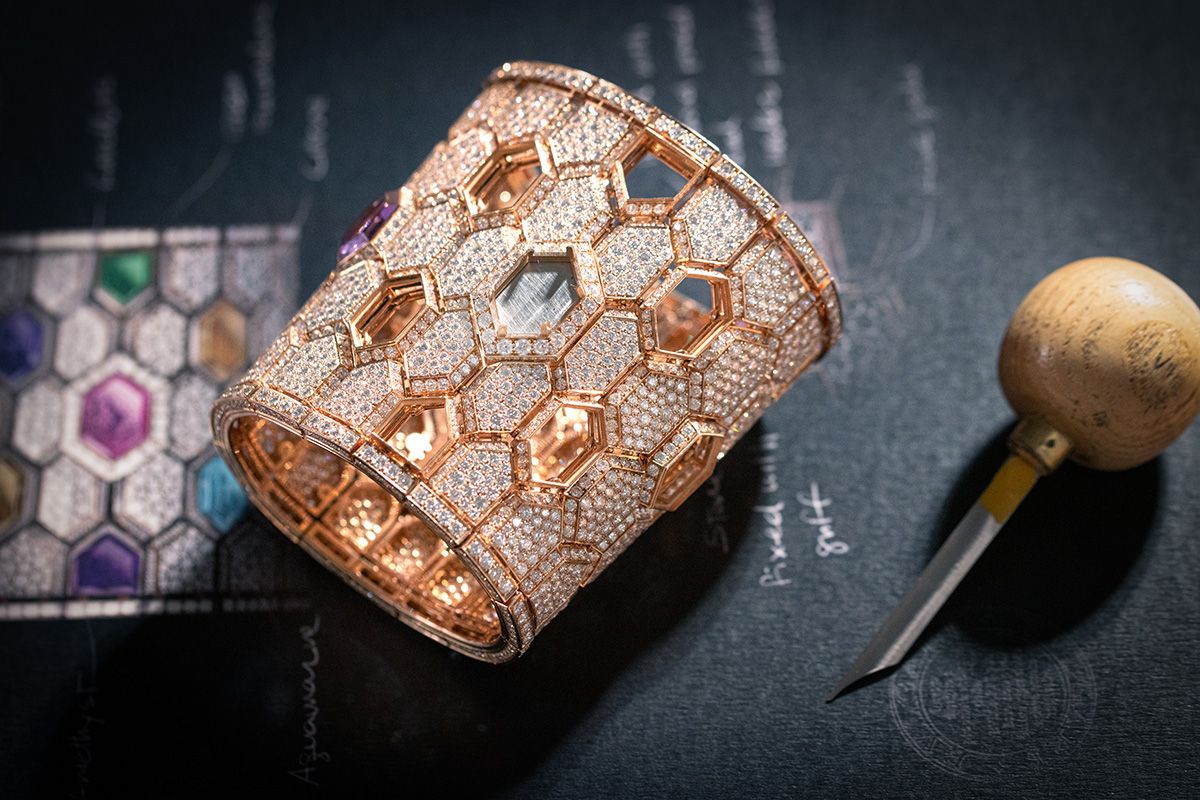
This spring, that union was on full display at the annual Watches & Wonders fair in Geneva. Often the talking points are the mechanical heavy hitters. Yet this year, the artistry was just as remarkable as the engineering, with new takes on much-loved classics. Case in point? The Bulgari Misteriosi Cleopatra cuff watch with diamond dial peeping out from behind a faceted rubellite. A new Pallini in Serpenti form with gold bead or diamond scales also slithers into the spotlight but the most daring iteration of the Serpenti yet is a vision of sleek minimalism signalling a new design era according to Fabrizio Buonamassa Stigliani, Bvlgari’s Product Creation Executive Officer. “Aeterna is the rebirth of our iconic Serpenti. I wanted something different and modern. We removed the eyes and made the design sleeker and more contemporary. A futuristic version of Serpenti for a different type of clientele.”
The 60s were also a period of metamorphosis for Paiget reflected in their ‘Piaget Swinging Sautoir’ in rose gold fringed with yellow sapphires, cornaline, diamonds, white opal and ruby root beads which transforms from wristwatch to necklace illustrates that perfectly. “A watch is first and foremost a piece of jewellery” Yves Piaget once said and as the pioneers of pop art and Op art infused designs, Piaget collaborated with John-Claude Gueit as much stylist as watch designer to bring art, craft, technology and design together.
The art of Cartier also manifested at the fair in a vintage-leaning design family called Tressage with twists of gold framing a snow-set diamond or lacquered dial arching around the wrist in almost a free-standing sculpture acting as a bridge between the ever-evolving panthère now bathed in white diamonds and the more utilitarian Tank Louis Cartier – both of which see new creations this spring.
Going further back in time, just as Faberge before the Russian Revolution experimented with the plainness of stone fruit and vegetable object d’art as a palette cleanser to his extraordinarily ornate eggs, H. Moser & Cie have from their base in the Vallée de Joux produced a wildly bejewelled Streamliner Skeleton with baguette and rose-cut diamonds ensconced in every crevice. Having experimented with the emptiness of Vantablack dials, composed of carbon nanostructures absorbing 99.965% of light and even a circular watch case made from Swiss cheese, their famously minimalist design has been turned upside down in this watch to dramatic effect.
The science of space is explored in Vacheron Constantin’s Traditonelle Moon Phase, powered by Calibre 1410 AS/270 and tracking the lunar cycle with 122 years of accuracy. 270 pieces in reference to their 270th anniversary this year come with a high precision astronomical moon phase on a hot pink strap with a smattering of diamonds on the bezel. Alchemy in midnight blue Aventurine glass as a dial adorns the L’Heure du Diamant Moonphase at Chopard embracing their new 09.02-C self-winding movement. As legend has it, that in the 17th century, copper filings were accidentally dropped into molten glass at the Murano glass making workshop in Italy and a unique material called “peravventura” meaning ‘by chance’ was created which became Aventurine. Chopard have encircled theirs in fat juicy diamonds in a setting of their own design.
Aside from Pop and Op art, perhaps the most prevalent art movement to influence watchmaking is Art Deco which emerged in the 1920s after WWI conjuring up geometric lines. In Jaeger-LeCoultre’s Reverso One Precious Colours, a mother of pearl dial flips to reveal grand feu enamel on the reverse set with diamonds and fired at 800 degrees centigrade up to 15 times with drying phases at 200 degrees in a masterclass of patience as well as an understanding of metier d’art from their in-house decorative crafts atelier. Flowing lines of artistic beauty energetically executed by skilled artisans bring the Reverso, first launched in 1931 up to date.
Art Deco experienced a golden age until 1939 when modernism took over and at Van Cleef & Arpels a watch called the Rabun Mystérieux brings strong lines and abstraction to the fore combining both using the Mystery set gem-setting technique which they patented in 1933. As art forms overlap and converge, watches and jewellery do the same, whether in the most chi chi of circles in Rome or quietly in the workshops of the world’s best watchmakers.
Written by Melanie Grant for Harrods Magazine in July / August 2025 issue.